Saskatoon (Serviceberry)
☠ Poisonous lookalikes — know these first
Before any of the good news: these are the plants this species gets confused with, and the exact marks that separate them. Learn these first.
Common buckthorn (Rhamnus cathartica)
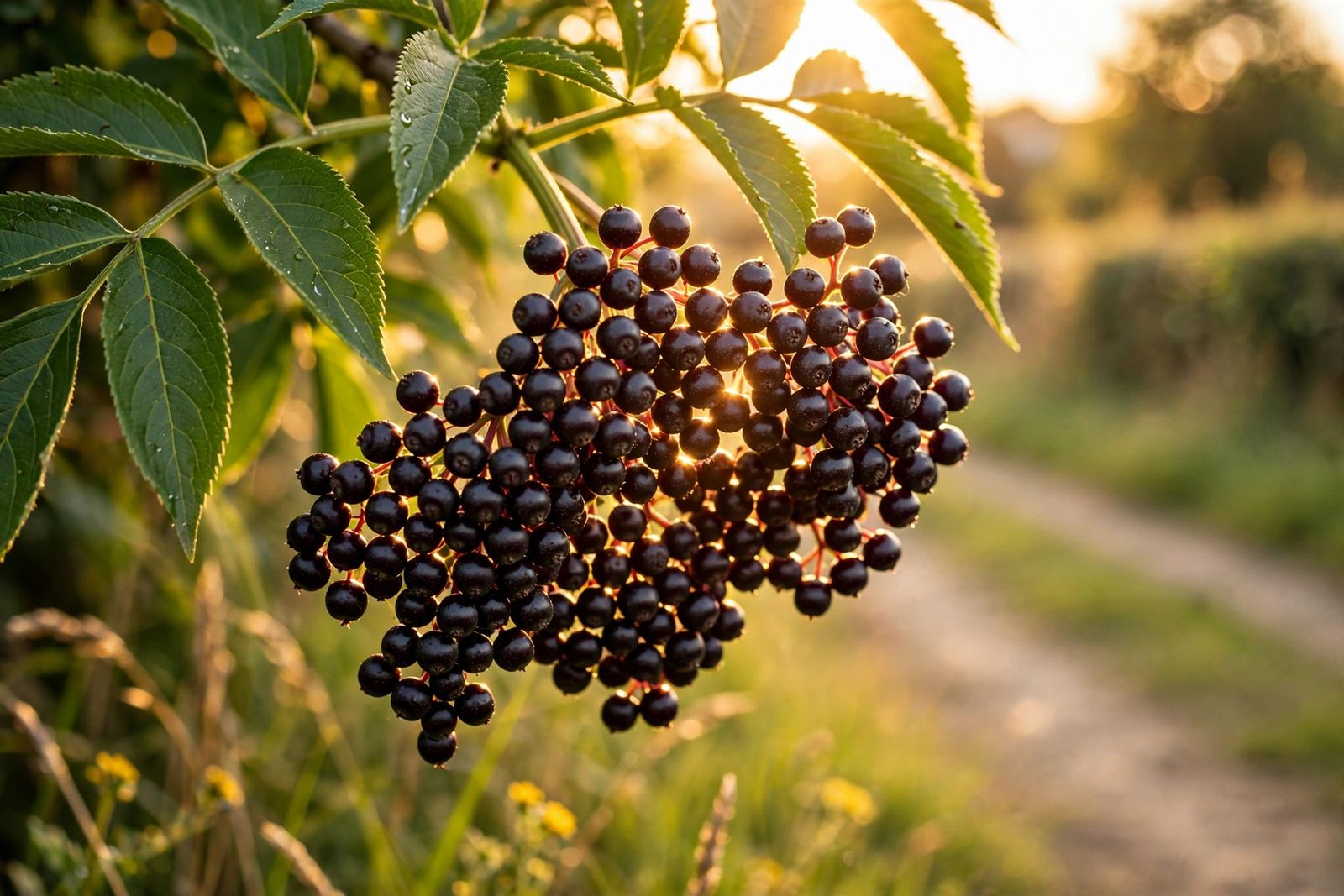
This is the one that matters. Buckthorn berries are glossy black and carry NO crown — the end opposite the stem is smooth and unmarked. The shrub's twigs often end in a short, sharp thorn, and its oval leaves show strongly curved side veins that arc toward the leaf tip. A saskatoon always wears its little crown and never grows thorns. Check for the crown on every berry; check for thorns on the bush.
Risk: Toxic. Buckthorn berries contain anthraquinone compounds including emodin and cause severe cramping and diarrhoea. This invasive shrub grows in exactly the fencerows and edges saskatoons favour, so the crown test is not optional — it is the whole routine.
Chokecherry (Prunus virginiana)
Chokecherry fruit hangs in long, elongated clusters like a bunch of tiny grapes, ripening dark red to black, and each fruit holds a single hard pit. Saskatoons hang in shorter, looser clusters and hold several small soft seeds. Chokecherry leaves are finely toothed all the way around the edge; saskatoon leaves are toothed mainly toward the tip.
Risk: Serious if handled carelessly. Chokecherry pits and leaves contain cyanide compounds — never eat the pits or chew the leaves. The cooked pulp is the traditional food part; the cluster shape and the single pit tell you this is a different plant, and it should be treated on its own terms, not as a saskatoon.
Pin cherry (Prunus pensylvanica)
Pin cherry carries bright red fruit in small rounded clusters on long individual stalks, each with a single pit. Saskatoon fruit is larger, dusky purple-black rather than cherry red, and crowned.
Risk: Same pit caution as chokecherry. The red colour, long stalks and single pit separate it clearly once you look.
The saskatoon is the berry the prairies run on — deep purple, sweet, and rich enough to anchor pies, pemmican and a city’s name. It’s also the first species in this guide where carelessness has a price, because an invasive, toxic shrub fruits black berries in many of the same fencerows. The good news: a saskatoon announces itself with a mark buckthorn cannot fake. Learn that mark and this becomes a safe, joyful pick.
In the east, the saskatoon belongs to the Amelanchier canadensis complex of serviceberries — the same crown test and the same cautions apply to the genus across the country.
Identification
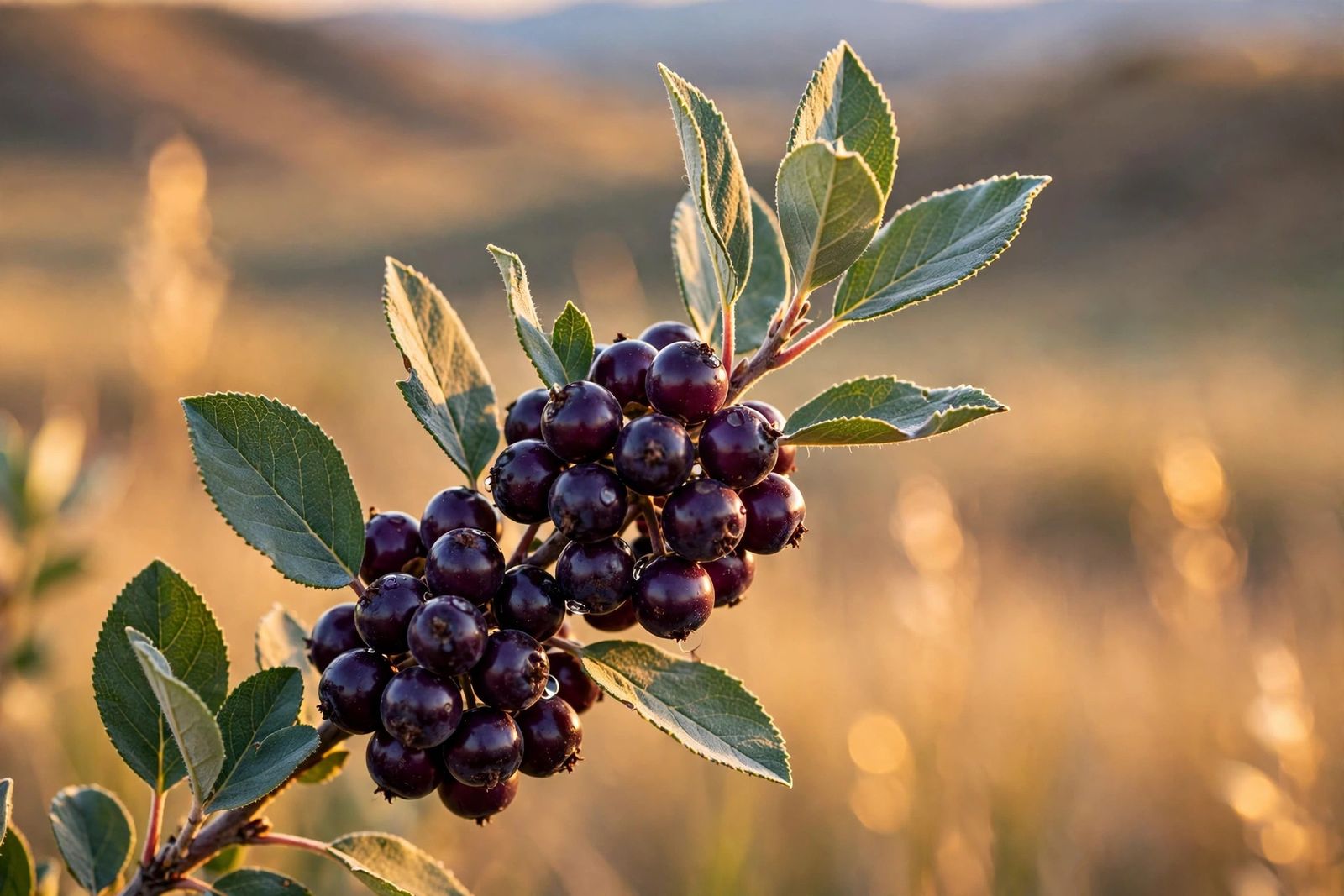
The crown. Every saskatoon berry carries a small, visible crown — a little ring of dried flower remnants at the end opposite the stem, exactly like the crown on a blueberry. It is there on red unripe fruit and on ripe purple fruit alike. This is the master mark. If a dark berry on a shrub has no crown, it is not a saskatoon, whatever else it resembles.
The fruit. Round, roughly the size of a blueberry or a little larger, ripening green to red to deep purple-black, usually with a soft dusty bloom on the skin. Inside are several small, soft seeds, and the flavour is sweet with a distinct almond note that comes from those seeds. Fruit hangs in short, loose clusters — not the long grape-like racemes of the cherries.
The plant. A thicket-forming shrub or small tree, anywhere from 3 to 12 metres tall depending on site, with smooth brown bark and slender branches. It suckers freely, so it usually grows as a many-stemmed clump rather than a single trunk — and critically, it never grows thorns.
The leaves. Oblong to nearly round, coarsely toothed mainly along the upper edge and toward the tip, with the lower edge often smooth. That half-toothed pattern is a useful supporting mark when fruit is young.
The flowers. In spring, before or just as the leaves open, the shrub covers itself in clusters of white, five-petalled flowers. A saskatoon in bloom is worth marking on your calendar and your map — the fruit follows roughly six to eight weeks later.
Season and habitat
Saskatoons fruit in June and July on the prairies and through much of the interior, running into August in northern districts and cooler coastal sites. The harvest on any one bush is short — often a week or two at peak — and the birds know the schedule as well as you do.
This is a plant of edges and openings: fencerows, wooded draws and coulees, the margins of aspen stands, clearings, stream banks and open rocky slopes from low elevation nearly to treeline. It is common in lower-elevation coniferous forest edges and conspicuous after disturbance — fire, clearing, or an insect outbreak will often bring a thicket into heavy fruit. Its range runs from Alaska down the Pacific side and east across the plains to Ontario and Quebec.
Harvest and preparation
Pick at full colour: deep purple-black, plump, and releasing easily. Red berries are unripe and mouth-puckering; they’ll tell you so. Strip gently by running a cluster through loose fingers over a bucket, then sort at home — this is when the crown test gets its second shift. Every berry in the bowl should wear a crown. Anything smooth, glossy and crownless gets discarded without debate, and so does anything from a bush you noticed thorns on.
Fresh saskatoons keep a few days refrigerated. They freeze beautifully, dry well in the traditional style, and cook into pies, jams, syrups and preserves with almost no help beyond a little lemon. Eat a modest portion the first time you try a new patch, as with any wild food, and let your stomach vote before you go back for pie quantities.
A word on sharing: saskatoons fruit for bears, birds and every other forager on the land. Take what your household will use, spread your picking across bushes, and leave full branches standing. A thicket picked fairly will out-pick a stripped one over the years.
Where you may pick it
Saskatoons on your own land, or on private land with the owner’s clear permission, are yours to enjoy. Public land is a patchwork — most parks prohibit removing fruit and plants outright, while some other public lands allow personal gathering — so confirm the rules for your exact patch before filling a bucket, using Is It Legal to Forage in Canada? and the Where Can I Pick? checker. Five minutes of checking protects both the thicket and your afternoon.
Questions
How can you tell a saskatoon from common buckthorn?
Check for the crown. A saskatoon always wears a little blossom-end crown, like a blueberry, and never grows thorns. Buckthorn berries are glossy black with no crown — the end opposite the stem is smooth and unmarked — and its twigs often end in a short, sharp thorn. No crown? Don't pick.
Are buckthorn berries poisonous?
Yes. Buckthorn berries are toxic — they contain anthraquinone compounds including emodin and cause severe cramping and diarrhoea. The shrub grows in the same fencerows and edges saskatoons favour, which is why the crown test is not optional.
When are saskatoons ripe in Canada?
June to July on the prairies, and into August in northern and coastal districts.