Wild Blueberries & Huckleberries
☠ Poisonous lookalikes — know these first
Before any of the good news: these are the plants this species gets confused with, and the exact marks that separate them. Learn these first.
Common buckthorn (Rhamnus cathartica)
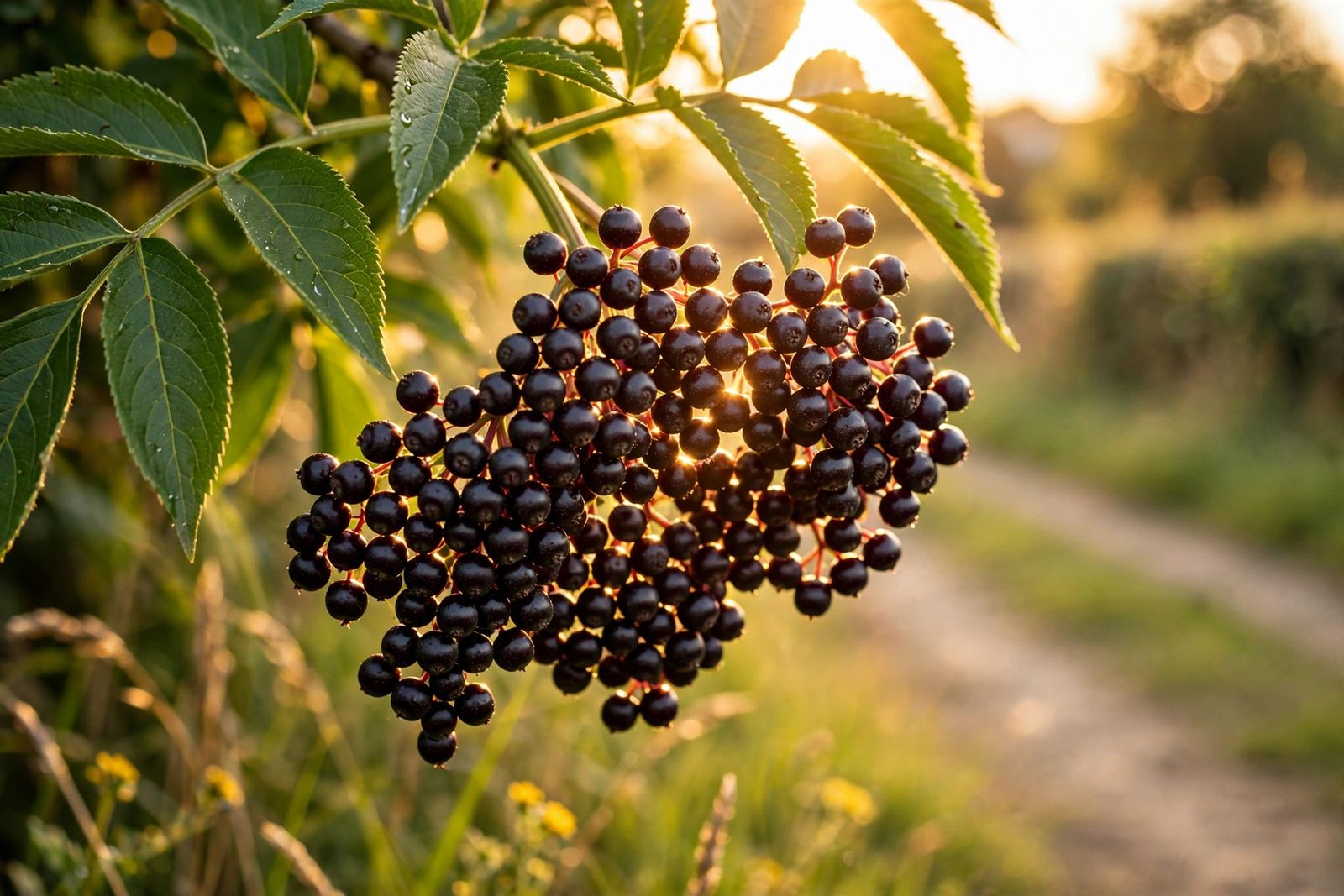
Buckthorn berries are glossy black and smooth-ended — no crown, ever. The shrub often carries twigs ending in short thorns, and its leaves show strongly curved veins arcing toward the tip. Ripe blueberries wear a dusty bloom and always carry the crown; buckthorn berries shine and never do.
Risk: Toxic, causing severe cramping and diarrhoea. Buckthorn invades the same edges and clearings where blueberries grow, which is exactly why the crown rule exists: any dark berry without a crown is rejected on sight, no debate.
Twinberry (Lonicera involucrata)
Twinberries are unmistakable once you look: glossy BLACK berries in back-to-back PAIRS, cupped in showy red bracts, on a shrub with opposite oval leaves. Blueberries are blue with a dusty bloom and grow singly or in loose clusters, never in paired black twins in red cups.
Risk: Treat as not edible and leave it alone. The paired arrangement and red bracts make it easy to reject — provided you are actually looking at your berries, which is the whole discipline of this page.
Crowberry (Empetrum nigrum)
Crowberry grows as a low, mat-forming plant with tiny needle-like leaves, in northern and exposed coastal sites. Its black berries are juicy but sit on a conifer-like mat rather than a leafy shrub, and they carry no crown.
Risk: A friendly confusion — crowberry is bland rather than dangerous. Learn the crown test anyway: if your rule is 'no crown, no eat,' crowberry simply reminds you the rule is doing its job.
If the saskatoon page taught the crown test, this page is where the crown test becomes law. True blueberries — and their western mountain cousins the huckleberries, Gaylussacia and mountain Vaccinium species — are among the safest and most abundant wild fruits in Canada. They are safe precisely because of one structural mark no poisonous berry in their neighbourhood carries. Pick by that mark and the rest is pleasure.
Identification
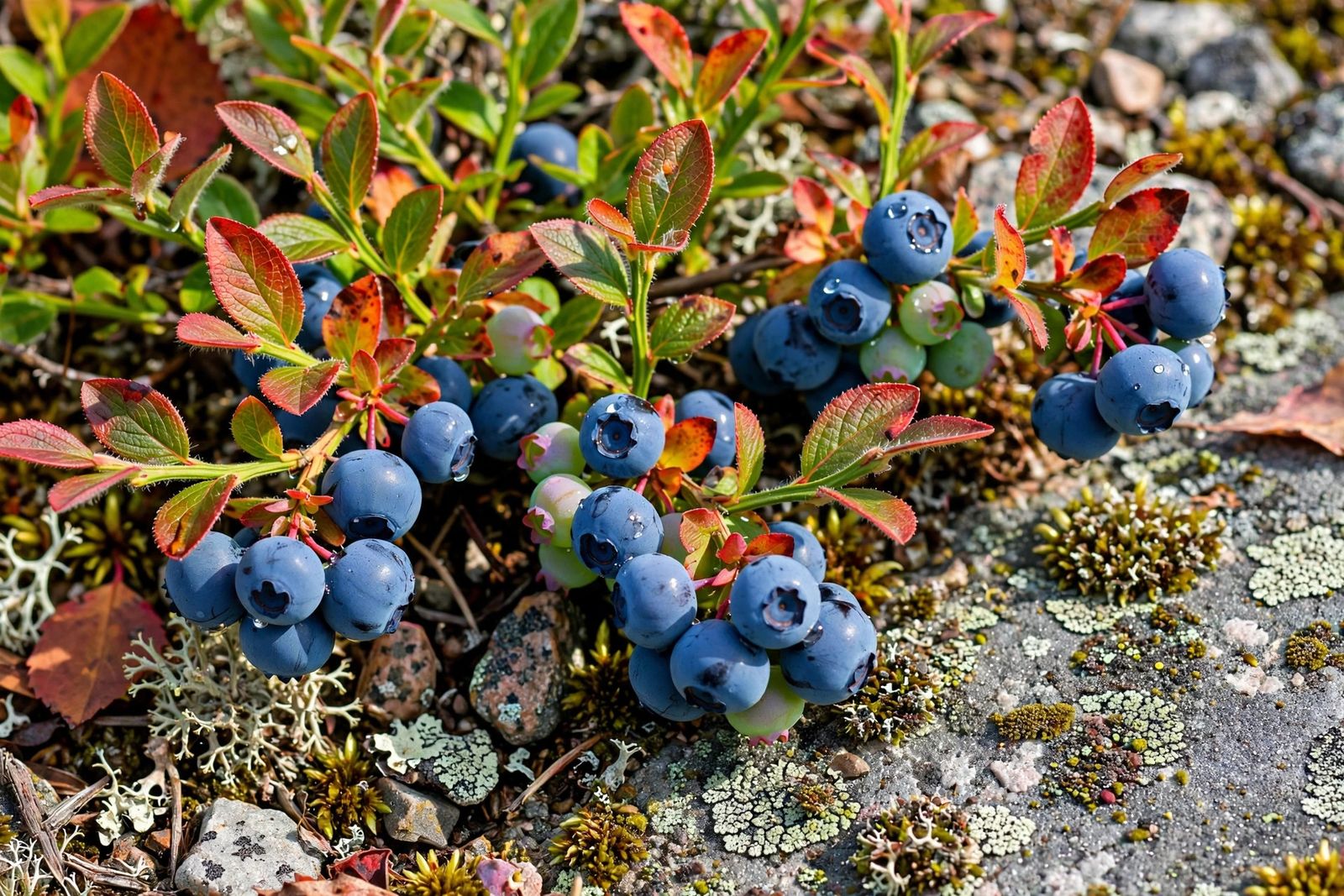
The crown. Turn any true blueberry over. Opposite the stem you’ll find a distinctive circular scar ringed by the remnants of the flower — a little five-pointed crown, the calyx end. It is present on every blueberry and huckleberry, green or ripe. This is the master mark, and the rule of this page is absolute: no crown, no eat. Apply it berry by berry as you sort, not bush by bush as you pick.
The fruit. Round, ripening from green through red-purple to blue or blue-black, and — in most lowbush species — wearing a pale, dusty bloom that rubs off at a touch. Under the skin the flesh is pale greenish, not purple-black and staining like the dark impostors. Seeds are tiny and soft, barely noticed in the eating.
The plant. A low shrub, knee-height or less for the classic lowbush blueberry (Vaccinium angustifolium), taller for highbush and mountain species. It never carries thorns. The leaves are small, oval, smooth-edged or nearly so, and on many species they turn a brilliant red in fall — a handy way to scout next year’s patches in October.
The setting. Blueberries fruit where the land is open, acidic and lean: rocky barrens, Canadian Shield outcrops, sandy plains, bog margins and — famously — recent burns and cutovers, where a managed barren can be a sea of blue by August.
Season and habitat
The window runs July to September and shifts with everything you’d expect: earlier on warm southern barrens, later in the north, at elevation, and on the coast. Mountain huckleberries in the west ripen through August into September as the season climbs the slopes. A known patch is worth visiting weekly; blueberries ripen in succession, and the difference between a good picking and a legendary one is often five days.
Lowbush barrens in the east — in Ontario’s Shield country, Quebec, and Atlantic Canada — are the classic ground, frequently on the same rocky, lake-dotted land where crowberry mats grow in the colder sites. The two plants share neighbourhoods, which is one more reason the crown rule runs the sorting table.
Harvest and preparation
Pick ripe: fully blue, bloom intact, releasing with a gentle roll of the thumb. A hand rake or berry scoop speeds things on a big barren, but comb gently — rakes strip leaves and unripe fruit too, and the bush has to live there all winter. A wide, shallow bucket and frequent sorting breaks beat one deep pail of crushed berries.
At home, spread the harvest on a tray and sort slowly. This is the crown test’s second shift: every berry gets its glance, and anything glossy-black, crownless, paired or otherwise off-script goes in the compost, not the bowl. Wash, then eat fresh, bake, freeze on trays, or dry. Blueberries keep their quality frozen better than almost any fruit — a January handful tastes like August remembered correctly.
First taste, as always, is a small one, even for a berry this familiar — and especially for children picking alongside you, who should be taught the crown rule as the price of eating from the bucket at all. It takes a minute to learn and it protects them in every berry patch on the continent.
Leave plenty. These barrens feed bears fattening for winter, and a patch picked with restraint fruits reliably for decades.
Where you may pick it
Blueberry ground is often public land — and often specifically managed, leased for commercial harvest, or lying inside parks where removing plants and fruit is prohibited. The patch in front of you can be any of those, and they don’t announce themselves. Before a serious picking trip, confirm the rules for your exact spot with Is It Legal to Forage in Canada? and the Where Can I Pick? checker. Crown on the berry, permission for the ground — both checks, every time.
Questions
How can you tell a true wild blueberry?
Turn it over. Opposite the stem, every true blueberry and huckleberry carries a distinctive circular scar ringed by the remnants of the flower — a little five-pointed crown. The rule of this page is absolute: no crown, no eat, checked berry by berry as you sort.
When are wild blueberries in season in Canada?
July to September, varying by region, elevation and species — shield country, barrens, burns and rocky ground in the east and north, and mountain huckleberries in the west.
What toxic berry is confused with wild blueberries?
Common buckthorn. Its berries are glossy black and smooth-ended — no crown, ever — and the shrub often carries twigs ending in short thorns. Buckthorn is toxic, causing severe cramping and diarrhoea, and it invades the same edges and clearings where blueberries grow.